Thursday, January 5, 2012

Why Lending Club is a Scam (Hint: It's not)


First they ignore you, then they laugh at you, then they fight you, then you win. 
Mohandas Gandhi


My parents visited us for Christmas. I owe a lot to my parents. From my father I learned the importance of temperance and striving for a spiritual life. From my mother I learned frugality and efficiency. With my father I often discuss politics and philosophy. With my mother I often discuss finances and investing. This particular visit, I mentioned that I was investing in Peer to Peer lending. The first thing she said was, "It's a pyramid. Get your money out while you can." This took me aback, but after thinking about it, I wasn't surprised. One of the common phrases I heard growing up was "never be the first on your block."

This leads me to Peter Renton's No Google, Lending Club is Not a Scam post (sociallending.net). It got me to thinking. Why would someone search for "Is X a scam?" While pondering this idea, I read Seth Godin's How much are you going to tip? post (sethgodin.typepad.com). This example he gave struck me:

There are two couples at the table, the waiter has brought separate checks and the credit card holder turns to the other credit card holder and tries to find out how to coordinate the tip.
Why?
I mean, if they were out just the two of them, would they ask what people at the other table were going to tip?
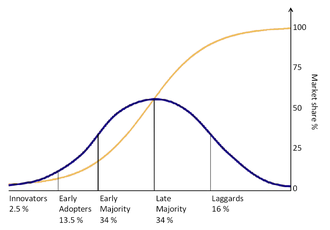
I've heard it said that all you need to have an opinion is a mouth. I guess the internet-age equivalent is, to have an opinion all you need is internet access. Searching (or is it googling) is an art. Using it for research on anything can be misleading at times, but especially for new and disruptive ideas. There is the idea of the S-Curve (see Wikipedia Diffusion of Innovations).

The S-Curve is a visual representation of the Gandhi quote at the beginning of this post. A very small number of people in society adopt a new idea. At first no one pays attention to it. Then it starts growing from just the innovators to the early adopters. This is where people laugh at you, as Gandhi said.

Next as the early majority starts joining in, those who see it disrupting status quo start whisper campaigns against it, as well as those with ill intentions see an opportunity to make a quick buck. Somewhere between early adopters and early majority, the government usually steps in with regulations. They want to make it "safe" for everybody. If it can survive the whisper campaigns, the malintent opportunists and the regulations, then we get the late majority and finally the laggards. My parents advice to "never be the first on your block" places you firmly in the late majority to laggard stage.

There is nothing inherently bad about being a late majority or laggard. And most people are not 100% in any of these categories (I believe my parents were the first on their block to have Magic Jack phone service). Some people are laggards just because they were born too late (I am a TV and telephone laggard). Most people tend towards late majority and laggard as they age (things just change too quickly).

With investing, while there is risk in being an innovator or an early adopter, it is matched with a large reward. If you are investing before the early majority hits, you can benefit from the surge. For those who are constantly investing as innovators or early adopters, you understand that there is risk and you expect to lose sometimes.

There is only one way to learn, through experience. There is only one way to get experience, through mistakes. However, there are two types of mistakes, your own or someone else's. If you rely solely on your own mistakes, it will be a tiring, expensive and demoralizing experience. You will find the most success in using a balance of the two. Try to learn all you can and at the same time, take some action. Expect to make mistakes.

So back to the idea of a scam. There are two types of "scams." One is when the other intentions of the other party of to take as much of your money as possible without giving you equivalent value. The second, and more pervasive in internet "scam" searches, is when the other party has full intentions of giving you the stated value, but the person puts the blame of their lack of education behind the word scam.

So is Lending Club a scam? You'll probably find more and more in internet searches as Lending Club grows, and for them, they feel they were scammed. For those who educate themselves, learning from their mistakes and those of others, you'll know if it is a scam, or you will get some valuable experience.

(In my opinion, Lending Club is not a scam. I believe that they have full intentions of helping their customers receive as much benefit as they can from their investment. Oh, and for my mother, it is regulated by the Securities and Exchange Commission.)

For help in finding Notes in FolioFN or selling Notes before they mature, see posts about Lending Club Extension.

Friday, December 23, 2011

A Revelation On My Grace Period Epidemic

So for those just joining us, my Lending Club experiment was going well since August, in fact, very well. So well, that I shifted all my fun investment money over to Lending Club and have regular deposits. Then in November I started getting Late Notes. I figured it would happen sooner or later. Then I started getting a lot of Late Notes. I also noticed that Late Notes don't sell very well. So I started discounting Grace Period Notes. If it doesn't go into Grace Period, it won't be late.

I noticed that I had a lot of Grace Period Notes. Since I wasn't even keeping track of Grace Period before, I just figured it was that way all along and was common. I attributed the Late Note epidemic to the season (and possibly the economy). Now that I am discounting a lot of Grace Period Notes, I feel it is affecting my return. However, I think I could have avoided most of this mess if I just understood what Never Late meant.

The way I look for Notes is to use all Percentages and select Never Late and Now Current (disable the other Now Late checkboxes). Then I sort by Yield To Maturity. My assumption was that every Note in the list had always paid on time (never in Grace Period).

Today I was using my Cash to buy up Notes when I noticed a steeply discounted Note with the highest Yield To Maturity. When I investigated, I found the following:
In the Browse Notes list it showed it was Current. However, they were still trying to process the payment. It was steeply discounted because someone was watching their portfolio closer than just the status reported by Lending Club. I would consider this Grace Period, but at least now I know.

So now I will screen each Note before purchase (clicking on the Current or Issued link) to see if it really is Never Late. I expect that would cut down on my Grace Period epidemic.


Monday, December 19, 2011

Five Months and The Good Times Roll (For Those Who Ran Off With My Money)


(See other Monthly Status Updates)

So after five months I've had a great run, followed by an avalanche of Late notes. I think I've had a total of 13 notes that have gone Late. One of them I've been able to sell off.

Every one of the Notes that have gone Late have made payments, but none of them have made payments to me. They were never late and were current when I bought the Notes (assuming that is what those checkboxes mean when Browsing Notes).


When they give my return, they obviously don't take into account that the Late notes are as good as gone. The chart above shows that of the Notes that go past 31 days, you have basically a 50/50 chance of getting any money back (they don't specify how many were fully recovered versus partially recovered, and how much that partially is). The site reports my return as over 21%. They no longer show your percentile. When they did show it, I had dropped solidly into the 99% (before I was waffling between being in the top 99% and 100%). My own internal reporting needs to change. I've been calculating my account value as the sum of what I paid for all my notes. What I need to use is the lesser of what I paid or what I am asking. I believe that will more closely represent my account value.


Of course, it may be more representative to consider Late Notes to be $0. I don't know what the conversion rate from Grace Period to Late is, but from 16-30 Days Late to 30-120 Days Late has been 100% for me. I've been able to stem the tide of Late Notes by being more aggressive at selling Grace Period Notes. I've still had a few slip into Late status. 

I've been selling Grace Period Notes at 80% of P+I (rounded down to the nearest dollar), and dropping the price by $0.10/day. Some of these Grace Period Notes have received payment and then sold at this discount. At first I was disappointed, but then I realized I didn't want the notes where the borrower was willing to go into Grace Period.

Late 16-30 Days I sell at 75% of P+I (rounded down to the nearest dollar), and dropping the price by $0.10/day. Late 31-120 Days I sell at 50% of P+I (rounded down to the nearest dollar), and dropping the price by $0.10/day. Not that discounting Late Notes seems to work. I have only sold one Late Note, and none have returned from the grave. I may consider being more aggressive at selling Grace Period Notes just to prevent Lates, since they seem to be the land of no return.


Most of my Notes (almost 2/3) are still F Grade. If I read the numbers correctly, 76% of the F Grade Notes are still Active (Current or Late). Of the Active F Grade Notes, 95% of them are Current. 25% of my Late Notes are F Grade while the compose 63% of all my notes. It appears that F Grade Notes are a pretty sweat spot.

E Grade Notes have roughly the same Current, Late and Default rates. They are also about 25% of my Late Notes. However, they only comprise 6% of my portfolio. So apparently I've been really unlucky with E Grade Notes.

Half of my Late Notes are G Grade. Given that about 1/3 of my portfolio is G Grade and that the stats for G Grade notes is a bit worse (91% of Active Notes are Current as opposed to 95% for E and F) that is not surprising. About 8-9% of E and F Grade Notes are in Default. For G Grade Notes, it's 14%.

You would think that due to the very small place that E Grade Notes hold in my portfolio (and that they are statistically equivalent to F Grade Notes) that they would not hold such a prominent spot in my Late Notes.


It is also interesting to see what Lending Club is doing to attempt to reclaim my money from the Late Notes. Below is a chart of the latest action Lending Club has taken on the Late Notes.

Months OldPayments MadeLatest Action
32Sent email to borrower
47PAYMENT Failed
52Borrower contacted Lending Club
53Sent email to borrower (three notes for this loan)
84Borrower located (skip trace)
85Borrower provided Bankruptcy counsel information
96Borrower filed for Chapter 7 Bankruptcy
96Collections Agency attempted to contact borrower
128Drafting lawsuit
1916PAYMENT Failed (previously: Borrower provided Bankruptcy counsel information)

So now after my big Late Note hit, I'm making some changes. First, Grace Period Notes seem to sell. I think I need to discount them slightly more than I have been. I'll be discounting them to 75% of value instead of 80%. Late Notes don't seem to sell at all (especially 31-120 Days Late). I'm also adjusting my Risk Factor for Note Grade. I used to just convert the letter to a number and the trailing number to the fraction (ie A1 = 1.1, F4 = 6.4). Now I will be squaring that (ie A1 = 1.1^2 = 1.21, F4 = 6.4^2 = 40.96). This should cause my tool to more steeply discount G Grade Notes, as they will be rated 36% more risky instead of 17% more risky. This may also weight my portfolio more towards E Grade Notes. Given the lower return and about equal risk to F Grade Notes, I'm not sure how I feel about that (not to mention my propensity to have Late E Notes).

Also, of note may be the states my Late Notes are from: SC, AZ (2 Notes), NY, VA (3 Notes, same loan), CA, OH (2 Notes), OR, MN. I was already weighting the risk of Notes based on state, thanks to Nickel Steamroller. Currently I weight riskier than average the following states (riskiest to less risky): CA, FL, NE, IN, MS, TN, IA, ID, MT, UT. I also weight the following states less risky than average (least risky first): WY, ME, OK, LA, CT, KY, NC, WV, KS, AL. I am adding "riskier than average) to my Late Notes' states (although I already had CA as the riskiest, I considered the others as average risk). Since SC and OH have two Late Notes each, I made them as risky as CA and FL. The other states I put their risk about equivalent to TN or IA.

And yes, I have three Notes from the same Loan and the Loan went into Default. I have identified some holes in my detection of Notes from Loans I already own. This is the risk I was trying to avoid. I think I've worked out a way to avoid the hole that got me three notes from the same loan and I think I discount Notes which I have multiple from the same loan.

If I assume that all my Late Notes are worthless, I think I'm basically back to my original investment, so 0% return. So now that I've learned a lot of lessons, I'm starting from the beginning again, and hopefully will come back with a vengeance!


Monday, December 5, 2011

'Tis The Season, I Hope

 The first three months were great: August, September and October. Since then, I've had 12 loans go late. One was sold, the remaining 11 I still have (not by choice).


My thoughts right now are that as soon as a note goes into Grace Period, it's time to start discounting it. I was just giving a mild discount (Principal + Interest rounded down to the nearest dollar). This led to three more notes going late. I am now going to 80% below P + I for any notes that goes into Grace Period. This is based on the recovery rate from the chart below.


I still discount 16 - 30 day late notes 75% and 31 - 120 day late notes 50%. Grace Period, Late 16 - 30 and Late 31 - 120 I drop in price $0.10/day ($0.60/week). It may be that I've been once bitten, twice shy, but I'll find a happy medium as I experiment with discounting.

I'm hoping that it is the end-of-year season that is causing the larger number of Grace Period and Late notes, or at least due to fluctuations in the economy.

What I'd really like to see is someone blogging about their experience in taking discounted E, F and G Grace Period or Late notes and making some nice returns from those. If everyone followed the advice I post, no one would be there to pick up the notes I don't want anymore.

Monday, November 21, 2011

How do I choose loans?

I just received an email from Peter Renton, of SocialLending.net fame, asking me a few questions about my use of FolioFN. I figured I would answer them in a blog post.

How do you choose the loans?


I first started choosing notes to buy based in several criteria. I would scrutinize the notes, read over the application, really make sure I was buying a solid note. However, that was when I was going to hold every note until completion.


I always believe that if something is not dear to you (no note is really dear to me) it has a price that it can be sold for. For instance, on Zillow.com, I have a Make Me Move price. I'm not in the market to sell my house, but if someone were to offer that much, I'd be willing to move. The same thing with my notes. My personal rule is that every note should be up for sale, even if no one will bite. The reason is simple, if someone does bite, they take the risk away from me and give me my return.


As I saw how easy and fast you can sell notes, I decided to change my strategy to be in the business of buying just about any note, but sell my favorites at a premium and the less desirables for minimum returns.


So, for the technical aspects of buying notes:


1. Use FolioFN Note Browser to filter only notes that were Never Late and are Now Current.


2. Then click on the Yield to Maturity column twice (sorts by Yield with the highest first).


3. This is when my hand written tool comes in. I have a custom Python script that runs while I'm on Lending Club's site (and FolioFN) that scrapes the web pages I am viewing and puts together account information and displays more meaning information. For instance, it will show me notes that I currently own another note from the same loan (or a purchase is pending), or notes that are larger than a $25 slice of the loan.


When I'm down to too little cash to buy a new, high yield note (generally less than $20), I then sort by asking price and look for the best Yield to Maturity for the money I have left. This can be a bit tedious if I have more than $15, as there aren't many positive yield notes in the under $5, but for each dollar added, it appears the number of notes grows exponentially, so you have to wade through more pages to find the best return.


How do you find the interface?


I find the FolioFN interface lacking. This is sad because the state I live in does not allow me to fund loans directly, which means much of the nice data and interface from Lending Club does very little for me. Here is my wish list for FolioFN's note browser:


  • Download all notes for sale in a format that a spreadsheet can import (making many of the following unnecessary)
  • Filter out notes from loans for which you already own a note (or a purchase is pending)
  • Filter out notes by asking price (ie notes asking $12 or less)


Selling notes on FolioFN is about as good as it can be, although the two step process of selecting which notes to put up for sale is a bit annoying. I like the one-button that sets all to principal + interest and then the button repeated so you can do that for just an individual note.


I do wish the sale window was more than one week. I'd love to have my notes for sale for a month, maybe two. The problem you would run into is what to do when you get a payment. Reduce the asking price by the payment amount? Reduce it by the principal only? I'd like both those options.


While I would like these tools built into the FolioFN website, not having them gives me a slight edge. With my custom tool, I get at a lot of these features (however, not the long term sales) via my custom Python script.


Wednesday, November 16, 2011

Fourth Month and Seven Deadbeats

(See other Monthly Status Updates)

Well, I knew this day would come. I have had seven notes that have gone past the Grace Period into the Late Period. Lending Club states that those within the Grace Period, I have an 83% chance of getting some money back from. Those that are Late 16 to 30 days, 75% chance of getting some money back. Late 31-120 days yields 55% chance. Note that this does not state that you will get all your money back, but get some back.


I'm changing my pricing strategy a little. Any notes in the Grace Period, I am now selling for Principal + Interest. This means I could lose up to 7 days of interest if it sells on the seventh day from when I put it up, but given that there is a 17% chance I could lose the entire note, it's little to give up. Then when a note goes Late, I start decreasing it's sales price by $0.10/day.


Of the 7 notes that have gone into Late, I've sold one so far. This is my first chance to get real data (although not enough for statistical significance) as to who defaults. Of the six notes I still own that are Late here is the info (notice that I bought all of these notes right before they stopped making payments):


Months OldPayments MadeLatest Action
42Voicemail left
74Collections Agency attempted to contact
75Borrower provided Bankruptcy counsel information
86Borrower filed for Chapter 7 Bankruptcy
118Drafting lawsuit
1816Sent email to borrower

We'll see how this plays out as far as collections. However, I'm still optimistic. My account is currently worth 5.1% more than the money I put in. On notes I sell, I get a median return of 38.5%. On average I sell notes after holding them for two weeks. The notes in my portfolio I've held for an average of 40 days. So it looks like my strategy holds on to some notes and cycles through others.

I've been bouncing around between 99% and 100% for my investor percentile. We'll see how that pans out over the next several months as we see what happens with these Late notes. Currently, I'm guessing I'm really in the 99.5% and the rounding gets me to 99% or 100% depending on the day.

The main thing I've been focusing on is keeping my time to a minimum on handling my account. My routine is to spend about 5 to 10 minutes a day each morning buying and selling notes.


Lending Club reports that I have a return of 21.22% (average is 9.64%). I think my Late notes will affect this, but I'm hoping my Grace Period and Late note selling strategy will minimum the impact on my return.

I'm still a small investor. I am over the 100+ Note range but not quite to the 400+ Note range. Of the 100+ Note investors, if I can stay in the top 6.5% of investors, I will still have a 15%+ return. My target is 16% per year, so 21.22% gives me some wiggle room.


So I think the changes to my strategy will be to:

#1 Do not buy notes that are in Grace Period
#2 Sell notes that reach Grace Period at value
#3 Discount Late notes by $0.10/day

This is where it gets really fun, how to mitigate risk and still make a good return. When I said I've been lucky so far, this is where we see what the real possibilities of Lending Club are.

Thursday, October 13, 2011

Third Month and Going Strong

(See other Monthly Status Updates)

Three months down and my luck is holding. Lending Club reports that I am getting over 20% (my target minimum is 16%). This appears to put me in the top 1/2%. I say that because I've been fluctuating between top 99% percentile and 100% percentile. I think they are rounding it. I can't seem to find how many investors there are on lending club, so I'm not sure if I'm in the top 5 or top 50.

I'm still trying to figure out where the problem is with about 1/3 of the notes I sell being sold for less than 16%. Of the notes that sell for less than 16%, they all sell for 1.7% to -100% (annualized). I'm hoping it's my tool. I now review my sales to make sure that I at least ask for the principal and interest.

I may also have my first default here soon (16-30 days late).


My strategy hasn't changed. Buying: I prefer to hold notes that have just been issued or are within the first year (the earlier the better). I only buy $25 fractions. I try not to buy notes from loans from which I already have a note. I want loans that are Now Current and Never Late. Then I look for the highest Yield to Maturity. Selling: I offer all my notes for sale. I set the sales price such that with taxes, fees, payments and purchase price taken into account I would get 16% to 32% annualized return if the note sold in 7 days.

I have a formula that determines the risk of a note using 30 different criteria (which my tool grabs from the original loan information and the note information pages):

Accounts Now Delinquent Amount Requested Credit Score Change
Credit Score High Credit Score Low Debt To Income
Delinquencies (Last 2 yrs) Delinquent Amount Expected Final Payment
Fraction Grade Gross Income
Home Ownership Inquiries in the Last 6 Months Interest Rate
Issue Date Last Payment Date Late Fees Received
Length of Employment Length Monthly Payment
Months Since Last Delinquency Next Payment Date Open Credit Lines
Public Records On File Purpose Revolving Credit Balance
Revolving Line Utilization Status Total Credit Lines

The more favorable these criteria are, the closer to 32% (I want to hold the note longer). This way I lower the price on riskier notes to have them (hopefully) sell before there are problems while less risky notes are held to collect payments until they start getting in the risky category.

As you can see I mainly have F and G notes (highest Yield to Maturity) as well as mainly 5 year notes.


This mix seems to jive with Lending Club's reported Return by Credit Grade. Grade F notes get the best return generally, with Grade G being slightly behind. Grade E notes are even further behind, which may be why I only have a handful of them.

While I have over 100 notes, Lending Club doesn't know about all of them. In the "Your Investment Numbers" chart above, it reports I only have 99 notes. The rest of my notes are being held in Foliofn. It takes a business day (sometimes more) for trades to settle. So at any point I may have a half dozen to several dozen notes bought or sold and pending settlement. It is a little confusing at times having notes and cash in the Lending Club account and pending sales or purchases in Foliofn.

So apparently my strategy can, at least in the short term, put me in the top 1.35% of all those with 100+ notes. On this chart they state that it takes a minimum of $2,500 to get to 100 notes. While that is not technically true (you could buy 100 notes near the end of their term for $5 to $15 each), you probably won't get the best returns buying those notes. Remember that the early payments are mainly interest, while the last payments are mainly principal. The value in a note for sale is the principal plus the next interest payment. However, the longer term value is the principal plus all future interest.


After three months I'm still having beginners luck. I'm still getting more than twice the average return. Still no defaults (although I have about a 25% chance that one of my notes will default). Still working it.